
Few parenting topics generate as much worry as screen time and sleep. You have probably heard that the blue light from tablets and phones is wrecking your child’s rest. Maybe you have bought blue-blocking glasses or installed a filter on every device in the house. Or maybe you have wondered whether any of this really matters.
The truth about Blue Light Kids Sleep is more nuanced than the headlines suggest. Some concerns are well-founded. Others are exaggerated. This article walks through what the research actually shows, what remains uncertain, and what you can do tonight to help your child rest better.
Blue Light Kids Sleep: What the Evidence Really Says
The story starts with a simple fact of biology. Light enters the eye and sends signals to a part of the brain that controls the body’s internal clock. Not all light is equal. Short-wavelength light—the kind that looks blue—is especially powerful at telling the brain that it is daytime. This is useful in the morning. It helps your child wake up and feel alert. The problem comes at night, when the brain should be winding down.
When blue light hits the retina after dark, it can suppress melatonin production. Melatonin is the hormone that signals to the body that it is time to sleep. Less melatonin means the brain stays in a more alert state. The result can be a delayed circadian rhythm—a internal clock that has been pushed later, making it harder to fall asleep at a reasonable hour.
Blue Light Exposure and Melatonin Production
How strong is this effect in children? The evidence is mixed, and that is where the hype often outruns the science.
On one hand, children appear to be more sensitive to light than adults. Their eyes are still developing, and the lens is more transparent, allowing more light to reach the retina. Research has found that when children are exposed to the same intensity of light as adults, their melatonin production drops by roughly twice as much. This does not prove that screens are destroying sleep, but it does suggest that children may be more vulnerable to blue light exposure in the evening.
On the other hand, not every study confirms a dramatic effect. A carefully designed experiment with toddlers found that watching a story on a tablet before bed did not suppress melatonin production compared with reading the same story in a picture book. The researchers measured melatonin directly through saliva samples and tracked sleep at home. The expected melatonin suppression simply did not appear. This does not mean screens are harmless. It means the mechanism may be more complicated than “blue light equals bad sleep.”
How Blue Light Affects Melatonin Production and Circadian Rhythm
Even if the melatonin story is not as simple as once thought, there is still good reason to pay attention to Blue Light Kids Sleep. The circadian rhythm is sensitive to light timing. Bright light at the wrong time of day can shift the clock later. This is why many children who use screens late at night go to bed later and sleep less.
Why Children May Be More Sensitive
Children are not just small adults. Their circadian rhythm is still maturing. Their sleep needs are higher. And their exposure to light is often less controlled. A child who uses a tablet in a dark bedroom is getting a concentrated dose of light directly into the eyes at close range. Even low levels of evening light can disrupt biological rhythms and delay sleep. This is not about panic. It is about recognizing that children’s developing systems may respond differently to blue light exposure than we might expect.
Sleep Quality and Bedtime Behavior
The clearest evidence is not about melatonin alone. It is about sleep quality and bedtime behavior. A systematic review of the literature consistently links screen use with delayed bedtimes, shorter sleep duration, and reduced sleep quality. One study of young children found that each additional hour of screen time was associated with about 10 fewer minutes of sleep. Over a week, that adds up. Over a childhood, the pattern can become entrenched.
Screen Time Before Bed: Practical Limits That Help
If you take one thing from the research, let it be this: the timing of screen time before bed matters more than the exact number of minutes. Pediatric guidelines consistently recommend a buffer zone. The American Academy of Pediatrics advises stopping screens at least one hour before bedtime. A review of the evidence on Blue Light Kids Sleep reached a similar conclusion: restriction in the one to two hours before bed is justified based on documented physiological mechanisms and observed sleep disruption in children.
Creating a Calmer Evening Routine
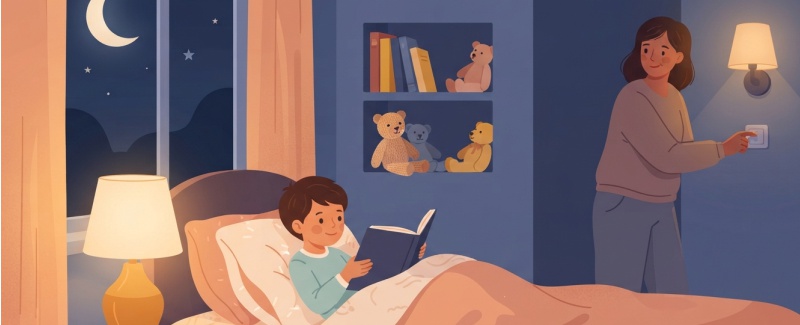
A buffer zone works best when it is replaced with something else. If you simply take away the tablet, your child may feel bored or frustrated. A calm routine helps the brain shift gears. Dim the lights. Read a book together. Do a quiet puzzle. Take a warm bath. These activities support sleep hygiene, which is the set of habits that make it easier to fall asleep and stay asleep. Good sleep hygiene is not about perfection. It is about consistency. A predictable wind-down sequence tells your child’s brain that sleep is coming.
Light Exposure at Home: What to Change
You do not need to turn your home into a cave. But small changes can reduce unnecessary blue light exposure in the evening. Use warm-toned lamps instead of bright overhead lights. Dim screens if your child must use one for homework. Keep devices out of the bedroom, where they can interfere with sleep quality long after the screen is off. The goal is not to eliminate all light. It is to make the evening environment work for sleep, not against it.
Sleep Hygiene: Building a Calmer Bedtime Routine
Sleep hygiene is the practical foundation of Blue Light Kids Sleep. It includes everything that shapes the transition from wakefulness to rest. A consistent bedtime. A dark, cool, quiet room. No screens in the bedroom. A predictable routine that signals safety and calm.
What the Research Says About Blue-Blocking Glasses
You may have seen advertisements for blue-blocking glasses for children. Do they help? The evidence is limited but interesting. One randomized trial with schoolchildren found that wearing partial blue light–blocking glasses for three hours before bed advanced the sleep phase and reduced daytime irritability, even though it did not change salivary melatonin production. In other words, the glasses may help behavior and sleep timing through mechanisms that are not fully understood. They are not a magic solution. But they are a low-risk option that some families may find useful, especially for older children who are reluctant to give up evening screen time.
The Bigger Picture: Content and Arousal
It is easy to focus on blue light exposure and forget the other ways screens affect sleep quality. A thrilling game or an emotionally intense video can activate the nervous system. The child’s heart rate may rise. Their mind may race. This arousal can delay sleep even if the light itself is not the main culprit. This is why screen time before bed is not just a light problem. It is a stimulation problem. A calm story on a dim screen is different from a fast-paced game or a social media feed. The content matters as much as the delivery.
If you are concerned about how screens affect your child’s eyes more broadly, our article on Digital Eye Strain in Kids: How Screens Affect Their Vision explores the visual side of screen use, including practical tips for protecting eye health during the school day.
The hype around Blue Light Kids Sleep often swings between two extremes. One says blue light is a crisis that will ruin your child’s health. The other says it is a myth with no real evidence. The truth sits in the middle. Light timing affects the circadian rhythm. Screen use before bed is associated with later bedtimes and poorer sleep quality. Children may be more sensitive to evening light than adults. At the same time, the melatonin evidence is not as clear-cut as it is sometimes presented, and other factors—content, arousal, and routine—play a major role.
You do not need to be perfect. A consistent sleep hygiene routine, a screen-free buffer before bed, and a calm environment are enough to make a meaningful difference. Start with one change. Keep it simple. Your child’s sleep is worth protecting, and the evidence supports a thoughtful, balanced approach rather than fear.
FAQs:
Is blue light from screens the only reason screens disrupt sleep?
No. Blue light exposure is one factor, but it is not the whole story. The content your child consumes also matters. Fast-paced games and emotionally intense videos can increase arousal and make it harder to wind down. Sleep hygiene—including a consistent routine and a screen-free bedroom—addresses both the light and the stimulation. A calm story on a dim screen is very different from a thrilling game at full brightness.
Do blue-light-blocking glasses really help children sleep better?
The evidence is promising but not definitive. A randomized trial found that blue-blocking glasses worn before bed advanced the sleep phase and reduced daytime irritability in schoolchildren, even though melatonin production did not change. Glasses may be a useful tool for some families, especially for older children. But they work best as part of a broader sleep hygiene routine, not as a standalone fix. The timing of screen time before bed still matters.
How long before bed should my child stop using screens?
Most pediatric guidelines recommend at least one hour. The American Academy of Pediatrics advises stopping screens one hour before bedtime. Some research supports a buffer of one to two hours for children, given their potential sensitivity to evening light. If one hour is unrealistic for your family, start there and adjust. The goal is to create a consistent, screen-free wind-down period that supports sleep quality and helps your child’s circadian rhythm settle into a healthy pattern.